
Melville’s Making of Moby-Dick
The WhaleThis flow follows Herman Melville from maritime experience through research and personal transformation to the creation and initial failure of his great novel.
increasing Bearing strength in each event
 decreasing
Bearing strength in each eventdecreasingA Boy’s Prophecy
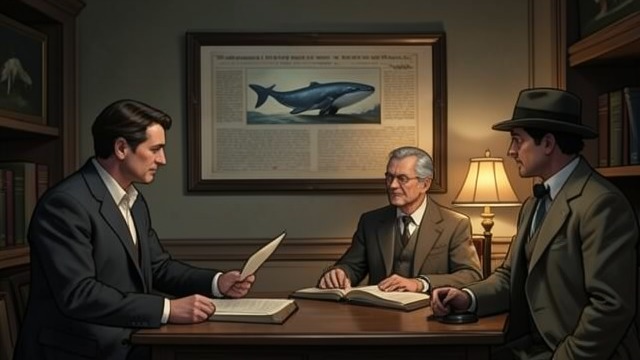
The Whale in the Picture
An early image
A picture of a harpooned whale, seen among his father’s belongings, lodges in Melville’s imagination. He later recalls that it seemed to foretell a life of travel.
Insecurity at home
After his father’s death and the family’s financial collapse, Melville loses the stability he had known. The sea comes to represent escape as well as danger.
The Acushnet Voyage
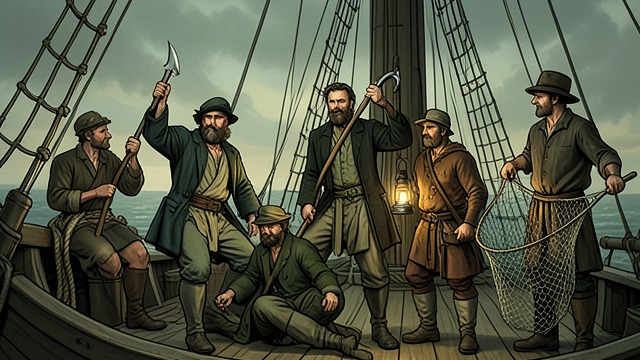
A Whaler’s Education
Leaving shore
Melville signs onto the Acushnet and enters a trade of long watches, dangerous boat work, and brutal processing. The voyage supplies direct experience of the whale fishery and of life among sailors.
Material for a book
He encounters the sea as work, risk, and collective experience rather than a romantic abstraction. The voyage becomes one source of the people, images, and procedures later used in Moby-Dick.
The Essex Story
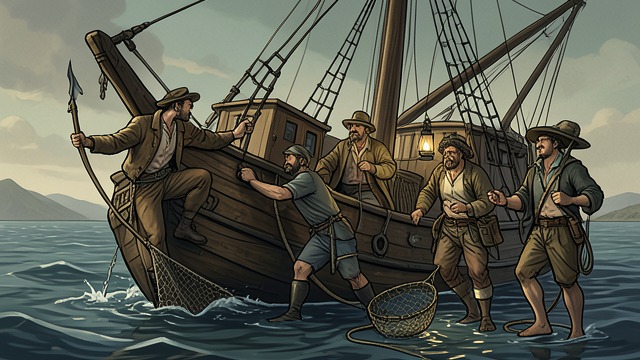
A Disaster of the Sea
The wreck’s account
Owen Chase’s narrative tells of the Essex, attacked and sunk by a sperm whale. Its crew survive the wreck only to confront starvation and the terrible collapse of human conduct.
A model for catastrophe
The story supplies Melville with a factual precedent for a whale that destroys a ship. Its terror becomes part of the imaginative architecture of Moby-Dick.
Hawthorne’s Influence
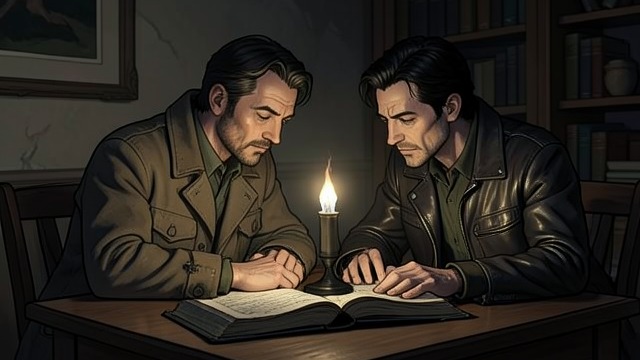
A Book Deepens
A consequential meeting
Melville meets Nathaniel Hawthorne in the Berkshires and becomes intensely invested in his writing and companionship. Their discussions and Hawthorne’s work encourage Melville to see greater symbolic possibility in his own material.
A changed ambition
The whale narrative grows beyond a conventional adventure. Melville brings metaphysics, political anxiety, desire, and questions of good and evil into the work.
Publication and Neglect
A Difficult Reception
Two editions
Moby-Dick appears first in Britain, where the ending is omitted, and then in an American edition. The book’s mixture of narrative, sermon, cetology, and digression leaves many readers confused.
A delayed reputation
The first edition fails to sell out, and Melville’s work does not receive lasting recognition during his life. Later readers transform the neglected book into a defining American novel.
During Melville’s childhood in New York City
From January 1841 and over the following years
During Melville’s research before writing Moby-Dick
In the summer and autumn of 1850
In 1851 and the years immediately afterward
